The year 2026 will be a year of major transformation for F1. As a pioneering season toward a new era, F1 will implement new technical regulations, fundamentally changing the development of F1 cars and the way competition is fought—from power units (PU) to chassis. Let’s take a look at what changes to technical regulations, teams, and driver lineups will occur from the 2025 regulations heading into 2026.
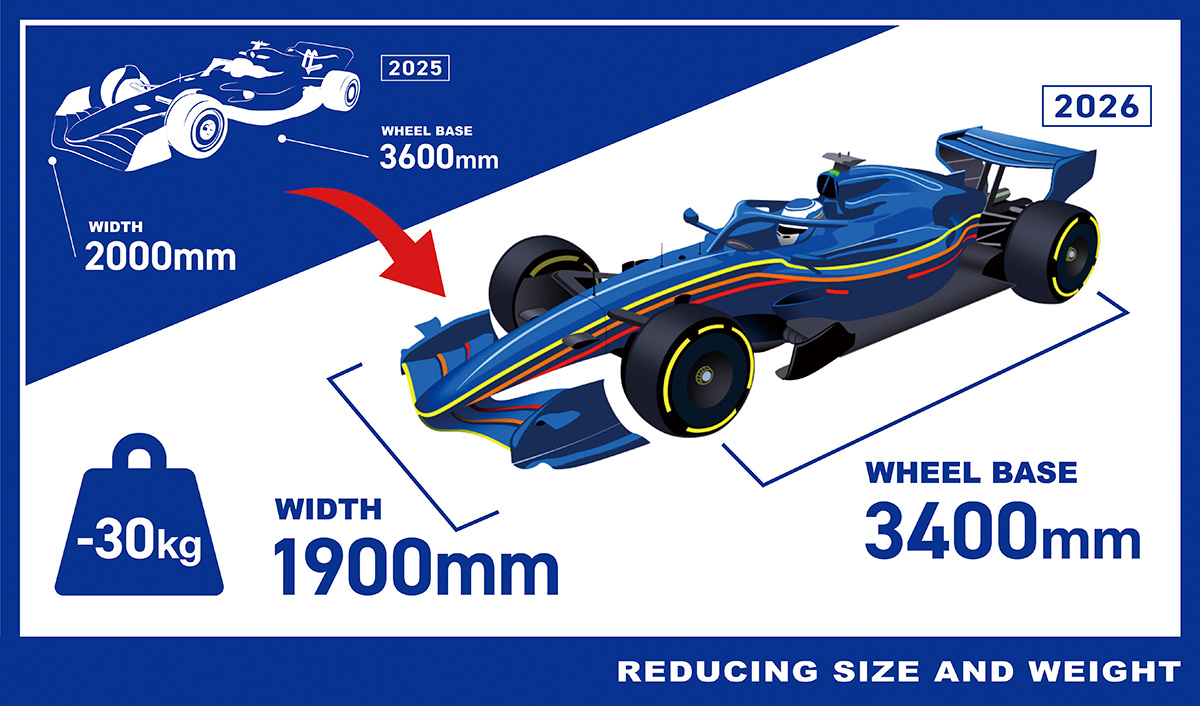
Starting with the vehicle aspect. The new F1 technical regulations were established with the theme of 'smaller, lighter, and more agile machines' to promote overtaking opportunities and close racing. In line with this theme, the car width has been reduced from 2000mm to 1900mm. The wheelbase (distance from the center of the front wheels to the center of the rear wheels) has been shortened from a maximum of 3600mm to 3400mm, and the minimum weight has been changed to 768kg, which is 30kg lighter than before. Additionally, with the chassis size reduced, the maximum floor width has also been reduced by 150mm.

With smaller cars than in 2025, the 2026 season is expected to see more race developments and side-by-side battles at the Monaco GP and Suzuka Circuit.
Furthermore, the front tire width is reduced by 25mm and the rear by 30mm. The tire outer diameter will also be reduced from the previous 720mm to between 705 and 710mm. While the reduction in tire width and diameter raises concerns about decreased grip levels, the overall weight reduction of the car is expected to minimize the loss of grip.
The power unit (PU) regulations have also undergone a major transformation. The 1.6-liter V6 turbo hybrid PU used from 2014 to 2025 had a power output ratio of 8:2 between the ICE (internal combustion engine) and the electric motor (MGU-K / kinetic energy recovery system).
In 2026, while maintaining the overall performance of the power unit (PU), the internal combustion engine (ICE) output will decrease from 550 kW to 350 kW to improve sustainability. Meanwhile, the electric motor output will increase from 120 kW to 350 kW, approximately tripling, changing the output ratio between the ICE and electric motor to 5:5. It goes without saying that the increased motor output and performance will be a major factor for PUs and winning in F1 from 2026 onward.
Also, due to the significant cost burden on manufacturers (PU manufacturers) and the technical complexity, the MGU-H (thermal energy recovery system) has been abolished. From 2026 onward, the PU configuration has become simpler, making it easier for new manufacturers to participate.
There are also changes in terms of fuel. F1 has set a goal to achieve carbon net zero by 2023, and as a step toward that, it has been using 'E10 fuel,' which contains 10 percent plant-derived ethanol, since 2022. From 2026, carbon-neutral fuel (CNF) made from 100 percent synthetic fuel that does not effectively increase carbon dioxide emissions will be used instead of this E10 fuel.
This CNF can be developed by each manufacturer and for each PU used. For example, Honda announced a contract with Saudi Arabia's national oil company Aramco, making it one of the key points in the development competition from 2026 onward.

Furthermore, to encourage more overtaking opportunities, a new "Manual Override" mode has been added. When the leading (escaping) car exceeds 290 km/h, deployment (energy recovery) gradually decreases, reaching zero at 355 km/h. Meanwhile, the trailing (chasing) car receives an override from the MGU-K, supplying an additional 350 kW and +0.5 MJ of energy up to 337 km/h, making it easier to overtake the car ahead.
This manual override can be used on any corner or straight, greatly increasing the driver's options for when to deploy it. On the other hand, it consumes a large amount of battery power, so how the driver and PU side manage its use throughout the race—including when to use it, fuel-saving driving to enable its use, and battery management—is something that won’t be fully understood until the season actually begins due to it being a new system.
Moreover, the efforts to promote overtaking do not stop there. Starting in 2026, the first-ever 'Active Aerodynamics' system in F1 history will be introduced. Until 2025, F1 has used the movable rear wing called the 'Drag Reduction System (DRS).' When a trailing car (the chaser) gets within one second of the leading car at designated detection points, it can activate the rear wing flap angle adjustment in the 'DRS zone' on the track, reducing aerodynamic drag to achieve higher straight-line speed than the leading car (the escapee). This system has contributed to promoting overtaking in F1 since 2011.
The new "Active Aerodynamics" system from 2026 will feature movable front wings as well as rear wings. There will be a standard "Z Mode" and a low-drag "X Mode," allowing drivers to switch freely between them regardless of location.
The active rear wing consists of three elements, and the previously seen lower beam wing has been eliminated. The endplates have been simplified in shape. Additionally, the front wing is 100mm narrower than before and is equipped with two-element active flaps.
There are various changes, but many of them are efforts to promote overtaking opportunities and close battles. The 2026 season is expected to showcase a very different way of driving F1 cars, strategies, and many intense battles.

Let's review the changes in participating teams and drivers for 2026. Kick Sauber is transitioning to the Audi F1 Team following the acquisition of the team by the German automaker Audi. Additionally, a completely new team named the Cadillac F1 Team, representing Cadillac—the luxury brand of American GM (General Motors)—will join the competition, increasing the number of teams to 11 and the total cars to 22.
Regarding power unit manufacturers, Renault will end its supply after the 2025 season, but 'Red Bull Ford,' 'Audi,' and Honda—which competed as Honda RBPT in collaboration with Red Bull in 2025—will fully return as a works team under the standalone name 'Honda.' This will increase the number of power unit manufacturers from four last year to five. It will be interesting to see how these three new entrants compete against the existing manufacturers, Mercedes and Ferrari.

There were also changes in the driver lineup. First, Isaac Hajaer (France) transferred from Racing Bulls to Red Bull. As a result, Japan's Yuki Tsunoda lost his regular seat and took on the role of Red Bull's test & reserve driver, shifting to a support position within the team. To fill the vacancy left by Hajaer, Racing Bulls signed Arvid Lindblad (UK), who competed in FIA F2 until 2025, as the only rookie driver for 2026.
The newly entered Cadillac team has appointed veterans with winning experience, Sergio Perez (Mexico) and Valtteri Bottas (Finland). It will be interesting to see how the experience of these two will contribute to the growth of the newly established team. Additionally, TOYOTA GAZOO Racing has become the title partner of the Haas F1 Team, and the team will compete as the "TGR Haas F1 Team."
The 2026 F1 season will kick off with the Australian GP from March 6 (Fri) to 8 (Sun), and the Japanese GP held at Suzuka Circuit will take place as Round 3 from March 27 (Fri) to 29 (Sun). We hope you will witness and engrave in your memory the dawn of this greatly changing new era of F1 at Suzuka Circuit.